San Diego business preparedness · JJ&S Environmental Services
When heavy rain affects a building, business decisions get complicated.
A flooded loading dock, water entering a ground-floor office, or a closed access road can disrupt a business long before the full damage is known. Deliveries may stop. Staff and tenants need answers. Equipment and inventory may be at risk. And once the water is gone, property teams still need to figure out what can be cleaned, what has to be repaired, and when the building is safe to use again.
For business owners, property managers, and facility teams across San Diego County, preparation is about more than keeping rain outside. It is about protecting people, keeping essential operations moving where possible, and making the right decisions before cleanup turns into a larger project. This guide walks through the practical steps to take before, during, and after flooding.
Where San Diego business flood risks begin
San Diego has several types of flood exposure. Some businesses are near river corridors and low-lying roads. Others deal with runoff from surrounding streets, hillside drainage, or water that enters through a roof, door, or underground parking entrance. A property does not need to be directly beside a river to suffer storm-related water intrusion.
The City of San Diego identifies Mission Valley, Sorrento Valley, Chollas, and the Tijuana River Valley among its mapped flood-prone areas. The County also describes flood hazards in parts of El Cajon, Ramona, and Borrego Springs. Those are geographic examples, not a claim that every property in these communities floods. Every business should look at its actual address, site history, and building layout.
River corridor
Mission Valley & San Diego River
River flooding and access-road closures can affect nearby commercial buildings, parking, and travel routes.
Urban drainage
Sorrento Valley & Chollas
Low points, runoff, and site drainage are important considerations for offices, warehouses, and other facilities.
South County
Tijuana River Valley
Flood exposure can affect local roads and properties in low-lying portions of the river valley.
These risks matter to businesses for a simple reason: even a relatively small flooded area can interrupt work across the rest of the building. A closed driveway can stop deliveries, a leak above a tenant space can delay occupancy, and water reaching stored materials can create questions that are not resolved just by mopping the floor.
Identify vulnerable areas in your facility
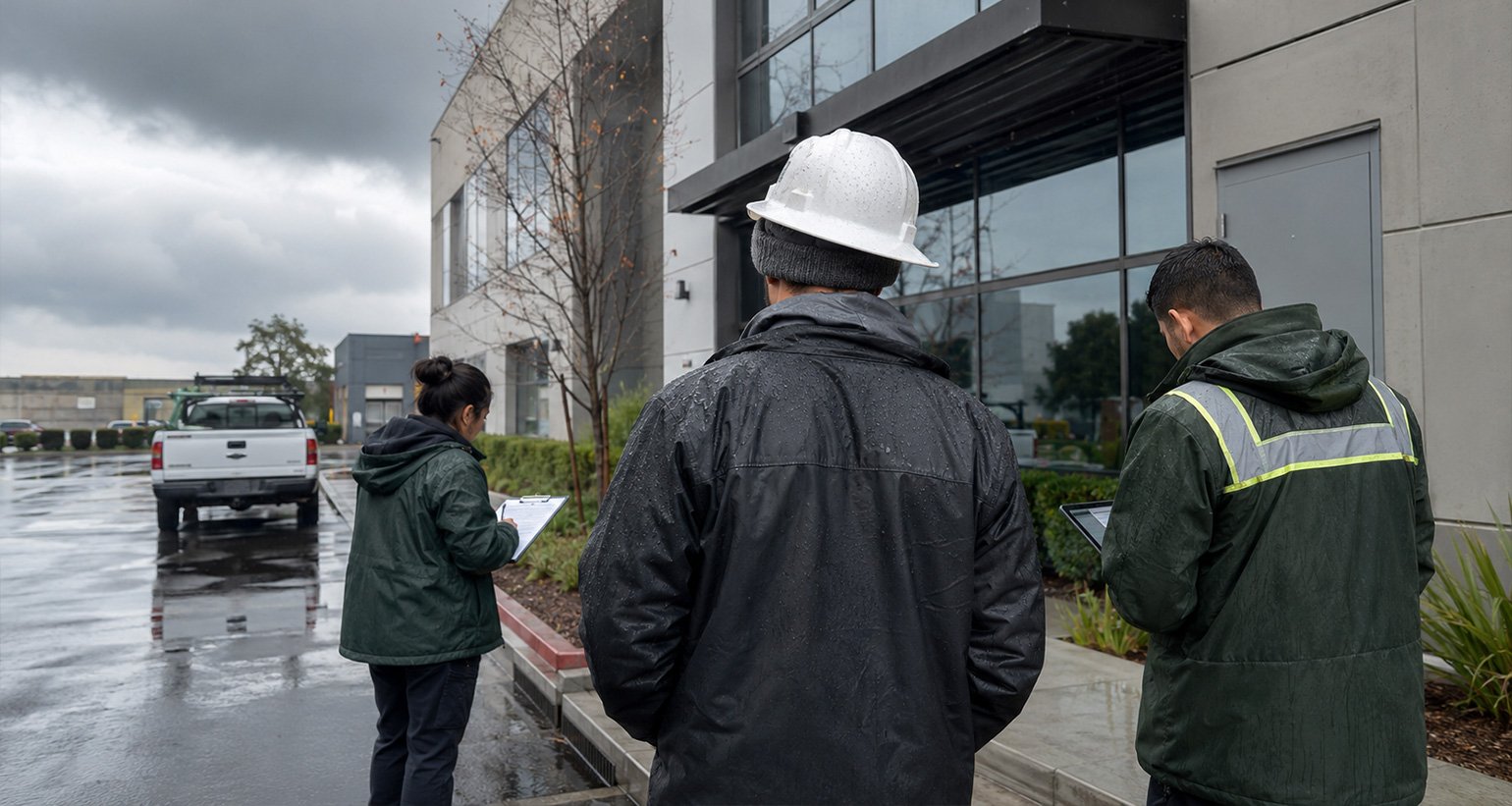
A useful commercial flood plan begins with a site walk. It does not need to be a complicated report. The goal is to notice where rain or runoff could interrupt the building and record who is responsible for checking those areas. A facility manager, maintenance lead, or appropriate building contractor can help with areas that are not safe to inspect yourself.
Exterior
Roof & drainage
Review gutters, roof drains, downspouts, exterior doors, loading docks, and spots where water has pooled after prior storms.
Ground level
Access & storage
Check garages, parking entrances, ground-floor storage, stockrooms, and any low point where water could reach inventory or equipment.
Building systems
Utilities & mechanical
Identify electrical rooms, elevators, HVAC equipment, telecom closets, and any systems that could limit safe occupancy if affected.
Around the site
Roads & outdoor materials
Review access roads, dumpsters, outdoor materials, work yards, and drainage pathways. Think about how runoff could carry pollutants away.
If you manage more than one building, keep a simple list of known problem areas by site. A record such as “water collects at the west loading dock after intense rain” is often more useful to an incoming property team than a general note that the building has flood risk. Include photographs, previous work orders, and the contact responsible for follow-up.
For tenants, the walk-through should also clarify what the lease places under the responsibility of the landlord versus the business occupant. Someone needs to own each action: inspecting the roof, clearing drains, protecting stored goods, contacting vendors, and deciding whether a space should close.
Prepare the property before heavy rain
Address water-entry points before a storm is forecast
Clean accessible drains and gutters, inspect door seals and known leak locations, and check whether exterior water flows toward or away from occupied areas. A drainage or roofing professional may be needed where grading, roof conditions, or other repairs are involved. Do not wait until heavy rain starts to send someone onto a roof or into an unsafe drainage area.
Move vulnerable equipment, inventory, and records
Think about what would be hardest to replace or most disruptive to lose: customer files, computers, stock, electrical equipment, original records, or specialty tools. Where practical, move those items away from floor level or out of known risk areas. Keep digital backups current and confirm that the people who may need them can actually access them if the office is closed.
Businesses with outdoor storage, construction materials, fuels, or waste containers should also check that those areas are secure before the rain. The County of San Diego’s storm preparedness guidance recommends inspecting materials, waste containers, parking, loading, and stormwater controls. This matters for protecting the property and avoiding runoff-related contamination.
Review insurance and keep a current property record
Flood-related damage may be treated differently from ordinary water damage under a commercial policy. Review the coverage, exclusions, deductibles, and any flood-specific requirements with your broker. If your business leases its space, confirm who insures the building and who insures equipment, improvements, inventory, and other contents.
Before a storm, take photographs or a short video of vulnerable rooms, equipment, and stored goods. Keep a list of key contacts and serial numbers where relevant. If damage occurs, that record can help the owner, tenant, insurer, and contractors understand the pre-loss condition.
Keep people and operations ready
Flood preparation has a people side and an operations side. Both matter. Employees should know how they will be contacted, what to do if roads close, and when they should stay away from the site. A property manager should know who has authority to restrict access or authorize urgent work. Tenants and customers should not have to guess whether a building is open.
Assign responsibilities before they are urgent
- Weather and decision lead: One person monitors official alerts and recommends closure or evacuation actions.
- Staff and tenant communications: A designated contact sends clear updates about access, working arrangements, and safety instructions.
- Facilities and vendors: Someone maintains the restoration, electrician, roofer, environmental specialist, and insurance contact list.
- Documentation: A person records decisions, photographs, work orders, and approvals as the event develops.
Have a workable continuity plan
Ask which functions must continue if the building is unavailable for a day or a week. Can staff work remotely? Can orders move through another location? Are customer records accessible? Does the business have alternate suppliers or a way to notify appointments? The answers do not need to be elaborate, but they should be written down and reviewed with the team.
For multi-tenant buildings, set expectations for shared entrances, parking, utility systems, and emergency communication. A retail tenant may have different reopening needs from a warehouse or medical office, but everyone benefits when access rules and decision-makers are identified in advance.
During the storm: make safe operational decisions
Use National Weather Service San Diego forecasts and official local emergency information to understand changing conditions. A watch means flooding is possible; a warning means flooding is occurring or expected. Local instructions, road closures, and evacuation orders should drive any decision to keep people on site.
Do not ask employees to enter floodwater to rescue equipment, clear a drain, or move a vehicle. If power, gas, or electrical systems may be affected, contact the utility or appropriate qualified professionals instead of attempting shutoffs through standing water. A closure decision can be inconvenient, but an unsafe facility can create a much greater problem.
When a property or access road becomes unsafe, tell staff, tenants, and customers what is known, what remains closed, and when they can expect the next update. Record who made the decision and why. That timeline can later help with insurance, tenant communication, and contractor coordination.
Post-flood recovery: the first six steps
Once floodwater has entered a commercial property, the pressure to reopen can be immediate. But standing water is not the only concern. Electricity, structure, contamination, hidden moisture, and building materials all affect what can happen next. The sequence below is designed to help property teams coordinate the right professionals without assuming every project needs the same services.
Safety first
Restrict access and confirm safe reentry
Keep people out of affected rooms until it is safe to return. Do not enter spaces with suspected electrical hazards, gas problems, unstable building components, or contaminated floodwater. Work with emergency officials, the utility, and qualified building professionals where needed.
Record
Document the condition and notify stakeholders
Photograph waterlines, wet finishes, inventory, equipment, entrances, and affected common areas when safe. Notify the insurer, property owner, tenant representatives, and other relevant parties. Start one incident log with dates, contacts, expenses, and work approvals.
Mitigation
Arrange qualified water removal and drying
A water-damage restoration provider can assess extraction, moisture detection, and structural drying needs. Ask for documentation showing which spaces and materials were affected. Do not assume a room is ready because the visible puddles are gone.
Materials
Evaluate suspect materials before tear-out
Water-damaged flooring, drywall, ceiling materials, adhesives, or painted surfaces may be removed during repair. Depending on the building, some materials could contain asbestos or lead. Arrange appropriate assessment before disturbing suspect materials; flooding does not itself create those hazards.
Environment
Address mold or contamination when needed
If moisture remains trapped, mold may become a concern. Sewage or polluted floodwater can also affect cleanup methods. The scope should reflect the water source, materials, occupancy needs, and relevant safety requirements, with the right environmental specialists involved.
Reopening
Return spaces to use in a coordinated way
Confirm that affected areas, utilities, equipment, and required cleanup work have been appropriately addressed before reoccupancy. Document any inspections or clearance work required by the project and keep employees and tenants informed about what is open and what remains restricted.
The EPA’s flood cleanup resources are useful for understanding mold, contamination, and safe recovery precautions. The exact work sequence on a commercial property depends on site conditions, applicable requirements, and the professionals responsible for the job.
Environmental risks that can change the cleanup plan
One of the most consequential decisions after a flood is what to do with wet building materials. If a wall, ceiling, or floor needs to come out, the work may go beyond ordinary cleanup. That is especially important in older buildings or spaces renovated many times over the years.
Mold can develop where moisture stays trapped
Even after surface water is removed, insulation, wall cavities, underlayment, and concealed spaces can remain damp. Moisture that is not addressed promptly can lead to mold concerns, and some materials are not easily dried in place. Restoration professionals handle moisture assessment and drying; specialized mold remediation may be necessary depending on what they find.
Asbestos or lead may affect demolition plans
Flooding does not make a building contain asbestos or lead. The concern arises when repairs disturb materials that may already contain them. Older resilient flooring, certain adhesives, ceiling products, insulation, and painted finishes can deserve evaluation before cutting, scraping, sanding, or removal. The proper approach depends on the material, building age, scope, and applicable regulations.
Floodwater can introduce other contaminants
Water entering from a street, sewage system, industrial area, or outdoor storage yard may carry more than soil. Where contamination is suspected, cleanup methods, material disposal, and reoccupancy decisions may need to be more controlled. This is particularly important for warehouses, food-related facilities, healthcare spaces, and businesses storing chemicals or other sensitive contents.
 How commercial recovery teams fit together
General water-damage restoration teams may be involved from water removal through structural repairs. For JJ&S, it is important to be equally clear about where our environmental work begins and ends. Different disciplines may be involved in one flood recovery project, and a good handoff keeps them from working at cross-purposes.
Phase 1
Safety & utilities
Emergency officials and qualified utility or building professionals address immediate entry, structural, and electrical hazards.
Phase 2
Water damage restoration
Restoration specialists assess water intrusion, remove standing water, manage moisture detection, and perform drying.
Phase 3
Environmental evaluation & abatement
Appropriate specialists assess suspect materials, mold, or contamination. JJ&S can provide relevant mold, asbestos, lead, or biohazard abatement services.
Phase 4
Repairs & reoccupancy
Repair trades rebuild as appropriate. The property team coordinates documented completion, occupancy needs, and communication.
Not every project follows that exact sequence. Some tasks must happen in parallel, and testing or clearance responsibilities vary. The important point is to confirm the scope and handoffs before wet materials are removed or new finishes are installed.
JJ&S Environmental Services works with owners, facility teams, general contractors, and restoration partners when flood-related projects involve mold remediation, asbestos abatement, lead abatement, or biohazard cleanup. We do not present these services as a substitute for water extraction or structural drying. They are a specialized part of recovery when environmental conditions call for them.
Long-term protection for San Diego facilities
The best time to learn from a flood is after the immediate work is complete and the experience is still fresh. Review where water entered, which areas were difficult to inspect, and whether the response plan gave people clear instructions. A small improvement to drainage, storage, or communication can prevent repeated disruption during the next rainy season.
Keep a building-specific flood record
For each site, save photographs, affected-room notes, contractor scopes, known material reports, and records of repairs. Document which water-entry points were corrected and which still need attention. If you manage a portfolio of buildings, use the same categories across locations so a new manager can understand the history without starting from scratch.
Review the plan with the actual people involved
A plan is only useful if the people who must act know what is expected. Before each rainy season, confirm emergency contacts, insurance information, vendor relationships, access procedures, and employee or tenant communications. Check that maintenance issues identified during the last storm have been resolved.
Consider improvements beyond temporary storm supplies
Where a property repeatedly floods, consult the appropriate building, drainage, or engineering specialists about longer-term measures. Facility changes may involve regrading, drainage improvements, roof repair, equipment relocation, or different storage practices. The right solution depends on the site and should not be assumed from a general article.
Facility readiness snapshot
Five things worth checking every rainy season
- Site drainage and known leaks
- Inventory, equipment, records, and outdoor material storage
- Emergency contacts and closure authority
- Insurance, lease responsibilities, and documentation procedures
- Restoration and environmental vendor contacts
Local resources for San Diego businesses
Official flood maps and emergency resources should support the property plan—not replace it. These sources are useful for checking local exposure, weather conditions, and practical business-preparedness guidance.
Flood risk
City flood-prone area maps
Mapped examples for Mission Valley, Sorrento Valley, Chollas, and the Tijuana River Valley.
Local weather
NWS San Diego
Regional forecasts, watches, and warnings; use current official reports during storms.
Stormwater controls
County storm preparedness
Local guidance for outdoor materials, loading areas, runoff, waste containers, and stormwater controls.
For additional guidance on exposed outdoor materials, runoff, and business stormwater controls, see the County of San Diego’s storm preparedness resources. For indoor recovery hazards, the EPA’s flooded buildings guidance provides useful background.

Talk with a JJ&S San Diego-area office
If flooding has affected building materials at a commercial property, JJ&S can help discuss the environmental remediation work that may be needed. These are local environmental services contacts—not emergency flood-response or water-extraction hotlines. For an immediate life-safety emergency, call 911.
If you are unsure which team serves your property, contact JJ&S directly and share the site address, photographs, and any available inspection reports. Those details can help determine an appropriate next conversation.
Frequently asked questions
Should a commercial building reopen once standing water is gone?
Not automatically. The building may still have electrical, structural, moisture, or contamination concerns. Reopening depends on the condition of the specific area and the assessments or work required to make it safe.
Does San Diego flood risk apply only to businesses near the river?
No. River corridors have recognized hazards, but localized drainage, low entrances, roof leaks, and severe runoff can also affect commercial sites outside mapped floodplains.
Who handles water extraction and structural drying?
Water-damage restoration specialists generally handle extraction, moisture assessment, and building drying. Environmental abatement contractors may be involved separately when mold, asbestos, lead, or specialized contamination is part of the recovery project.
When should we evaluate suspect asbestos or lead materials?
Before cutting, sanding, or removing building materials that may contain asbestos or lead. Flooding does not create these hazards, but repairs can disturb existing materials.
What records should a property manager keep after flooding?
Photographs, damage timelines, insurance correspondence, affected-room records, contractor scopes and authorizations, material assessment results, disposal documentation when applicable, and notes relevant to reopening.
How can we reduce business downtime during flood recovery?
Prepare contacts and responsibilities in advance, document the site, protect essential equipment and data, and coordinate restoration, environmental work, repairs, and occupant communications in a clear sequence. No plan can guarantee uninterrupted operations.
Heavy rain can interrupt a business in ways that are not obvious from the first puddle. Knowing your facility, planning for people and operations, and making careful decisions about damaged materials puts you in a better position to recover safely and with fewer avoidable surprises.
JJ&S Environmental Services
Planning repairs after water damage?
If a commercial flood or leak has affected walls, floors, ceilings, or other materials, tell us what happened. JJ&S can discuss mold, asbestos, lead, or specialized environmental remediation needs alongside your restoration and repair teams.
Request an estimateSafety note: Follow official emergency instructions. Flood hazards and building conditions vary by site. This guide is general information, not an emergency response service or a substitute for qualified site-specific assessment.